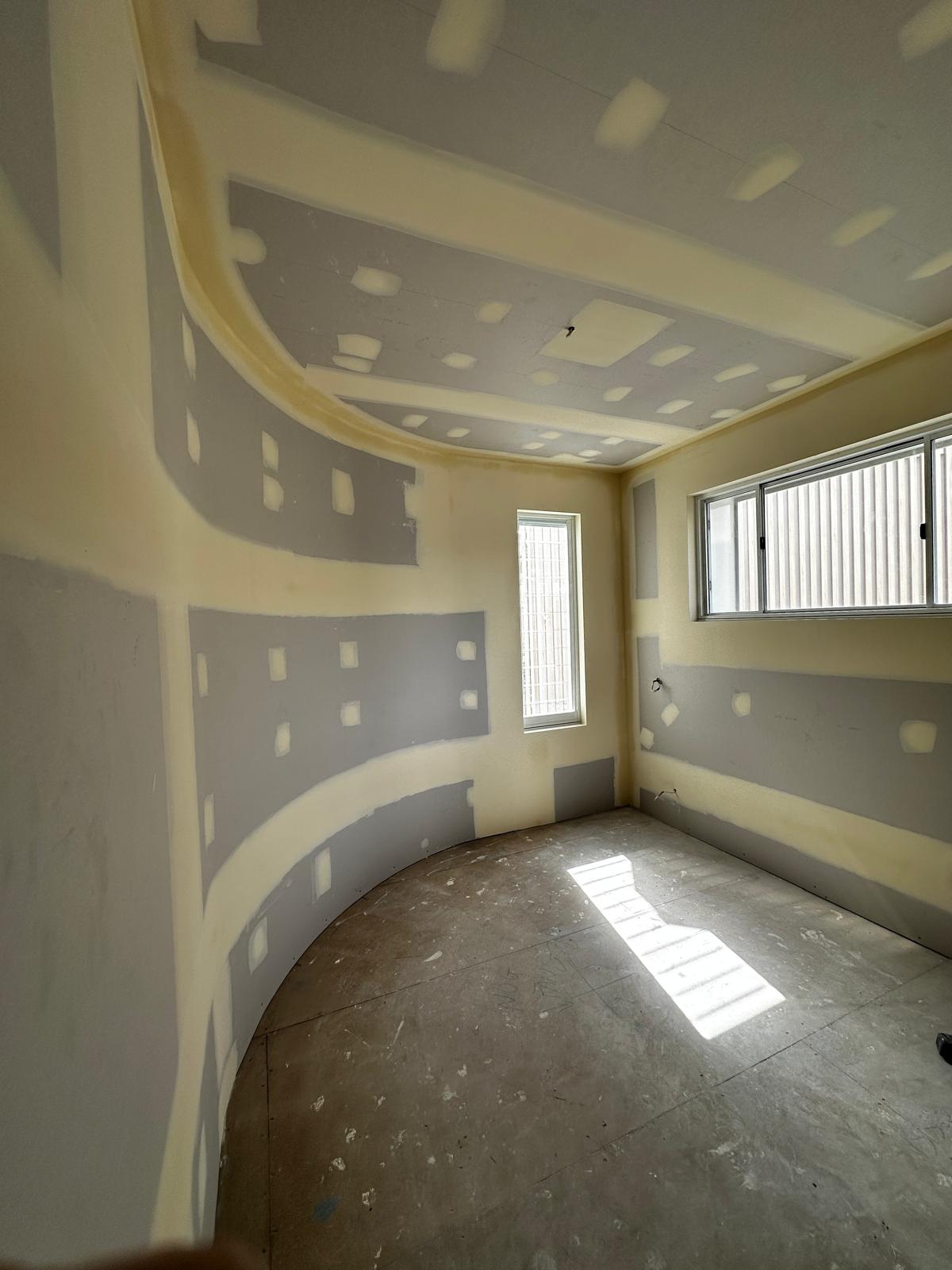
Premium plasterboard installation done properly. The right board for the right application, fixed and finished to a standard that holds up in Queensland's climate for decades, not years.
Standard, moisture-resistant, fire-rated, acoustic, or fibre cement: each application demands a different product. Specifying the wrong board in SEQ's humid climate is how walls fail within years. We specify correctly, every time.
Plasterboard installed to AS/NZS 2589:2017 using the correct screw-and-adhesive system, proper fastener spacing, and back-blocking at stress points. Not the way it looks like it should be done, but the way it actually should be done.
A Level 3 stop might photograph fine. Under LED downlights, raking light, or a gloss finish, it won't. We stop to the level the paint or finish demands, not the minimum that gets away with it on site.
Internal linings are the surface everything else depends on. The paint finish, the tile adhesion, the acoustic separation between rooms, the fire resistance of a wall assembly. All of it is only as good as what's underneath.
Clark Build Group installs plasterboard and internal linings across new residential builds, renovations, and commercial fitouts throughout South East Queensland. We supply and install standard plasterboard, moisture-resistant board, fire-rated assemblies, acoustic systems, fibre cement sheet, and architectural curved and feature applications.
Our builder's background means we understand how lining work integrates with the rest of the build: trades sequencing, inspection hold points, and the downstream consequences of cutting corners on the stop coat. We treat it accordingly.
Why Choose ClarkSouth East Queensland's subtropical humidity is one of the most frequently underestimated factors in residential building, and one of the most common causes of lining failures. A board specified correctly for Melbourne or Sydney is not automatically correct for the Sunshine Coast.
The most common failure we see in SEQ is standard plasterboard installed in areas that should have had moisture-resistant board. It performs fine for a few years, then the climate does what it does. Within a decade the wall is soft, bubbling, and eventually moulding behind the paint. The fix is always more expensive than specifying correctly from the start.
We know the climate. We know which applications demand MR board, which demand fibre cement, where waterproofing membranes are mandatory under NCC Part 10.2, and where the humidity-driven condensation risk is high enough to warrant vapour management even on internal walls. That knowledge is built into every specification we make.
MR board in every wet-adjacent space as a minimum. Fibre cement (Villaboard) where tile load or sustained moisture exposure demands it.
Membranes to AS 3740:2021 applied to the correct heights: 1,800mm from shower floor, 1,500mm radius from shower head. No shortcuts on waterproofing depth.
Queensland's 50-year design life requirement for termite management affects how lining work integrates with batten systems. We work with, not against, the termite management provisions already in the build.
Stopping compound applied and allowed to cure within the 10–35°C optimal range. High humidity slows cure. We schedule and manage accordingly, not against the conditions.
Not all plasterboard is the same product. The difference between specifying correctly and incorrectly is the difference between a wall that lasts decades and one that needs replacing in five years. Here's how each board type works and where it belongs.
10mm for walls, 13mm for ceilings. The workhorse of residential construction. Suitable for all dry, non-wet-adjacent interior applications. The screw-pattern and adhesive system matters more than most builders acknowledge; correctly fixed standard board is the invisible backbone of every well-finished room.
Mandatory in bathrooms, laundries, and any space with persistent humidity exposure. The green-faced board has a water-resistant gypsum core that resists softening under sustained moisture. Standard board cannot. Critical note: MR board is moisture-resistant, not waterproof. A waterproofing membrane is still required over it in wet areas.
13mm and 16mm boards with a modified gypsum core that retains structural integrity under fire exposure. Specified to Fire Resistance Level (FRL) ratings such as 90/90/90, the three numbers referring to structural adequacy, integrity, and insulation in minutes. Often installed in double layers for higher FRL requirements. Non-negotiable in party walls, stairwells, and Class 2 residential buildings.
Perforated boards (Gyprock Gyptone, Knauf Acoustic, and others) that absorb sound energy rather than reflecting it. Used in media rooms, home theatres, apartments, and commercial spaces where sound transmission between spaces is a design consideration. The perforation pattern (square, round, or slotted) affects both the acoustic performance and the finished aesthetic.
James Hardie Villaboard is the premium wet area alternative where tiles are heavy, substrate movement is a concern, or sustained moisture exposure goes beyond what MR board handles. Available in 6mm and 9mm, with the 9mm holding tile loads up to 60kg/m². Resistant to moisture, fire, termites, and rot. Backed by a 25-year warranty. The correct specification for shower recesses and tiled bathroom floors in SEQ.
Gyprock Flexible at 6.5mm can achieve convex curves from 250mm radius and concave curves from 450mm radius, installed in double layers for strength. Used for curved feature walls, barrel-vaulted ceilings, columns, and architectural bulkheads where standard rigid board cannot follow the form. Most applicators avoid it. We don't.
The most common cause of lining failure isn't bad materials. It's correct materials installed carelessly. Over-driven screws that break the paper face. Adhesive daubs too far apart. Stopping coats applied while the previous one is still curing. Wet area board installed without a proper membrane below it.
Sixteen years across residential and commercial construction in most parts of Australia means Johnathon has seen the consequences of all of these, and builds his process specifically to prevent them. The screw spacing is right. The drying times are respected. The stop coats are built up properly. The board specification matches the actual application.
Plumb, level, correctly spaced. Any framing issues identified and resolved before lining begins, not discovered three rooms in when the walls start pulling off square.
Adhesive daubs at 230mm centres maximum. Fasteners at 200mm perimeter spacing. Bugle heads countersunk without breaking the paper face. No shortcuts on the fixing pattern that turn into cracked joints six months later.
Base coat, second coat, finish coat, each allowed to cure before the next is applied. Back-blocked at stress points. Level 4 as standard, Level 5 where specified. Not a two-coat job dressed up as three.
Progress updates before you have to ask. On site when we said we would be. On the Sunshine Coast that's apparently a competitive advantage. We think it should be normal.
Plasterboard lining work follows a specific sequence, and the quality of the final finish is determined at every stage, not just the last one. Here's how a properly executed lining job works, from frame inspection to a paint-ready finish.
Studs checked for plumb, spacing, and any moisture or structural issues before a single sheet goes up. Problems found here are cheap. Problems found after are not.
Correct board type confirmed for each space (standard, MR, fire-rated, acoustic, or Villaboard) with waterproofing membranes ordered for all wet area applications.
Screw-and-adhesive system applied to AS/NZS 2589:2017. Fasteners at correct depth without breaking paper. Back-blocking installed at high-stress joints. Sheets cut and fitted cleanly around openings and penetrations.
Paper tape bedded centrally into the first coat of compound across all joints and corners. Fastener heads covered. Minimum 24-hour cure before any further work. Not 6, not 12, not "close enough."
Second coat widened and feathered. Finish coat applied thin and flat. Each coat cured and lightly sanded before the next. Diagonal sanding with 150–220 grit to avoid visible scuff marks under paint.
Surface checked under raking light conditions, the same conditions the first coat of paint will reveal. Any defects remedied before handover. Written care notes and warranty documentation provided.
Australian Standard AS/NZS 2589:2017 defines five levels of plasterboard finish. The level specified should match the paint sheen and lighting conditions of the finished space, not be selected for minimum labour cost. We discuss this with every client before the stopping begins.
Tape embedded in compound only, no additional coats. Visible tape and tool marks accepted. Appropriate for concealed spaces: ceiling plenums, service corridors, spaces above suspended ceilings. Not a painted finish level.
Concealed Areas OnlyTwo coats plus tape. Adequate for flat or low-sheen paint in areas with consistent, non-raking lighting. Garage interiors, utility rooms, and spaces where critical inspection isn't expected. The minimum that gets by in low-scrutiny conditions.
Flat & Low-Sheen PaintThree coats, fully sanded. The standard for residential living spaces receiving flat, low-sheen, or eggshell paint. What every properly finished bedroom, living room, and hallway should receive. The benchmark for quality domestic work.
Standard Residential | Our DefaultThree coats plus a full skim-coat over the entire surface. Required for semi-gloss or gloss paint, or any surface under critical raking light (LED downlights at low angles). Without Level 5, every joint and fastener head will telegraph through a gloss finish. The standard for high-end residential and commercial fitouts.
Gloss Paint | Critical LightingFor builders, project managers, and clients who want the technical detail: here are the standards and specifications that govern every internal linings installation we carry out.
The most common cause is structural movement. Timber framing shrinks seasonally and over time, placing stress on fixed joints. Incorrect fastener depth (over-driven or under-driven), insufficient adhesive coverage, and stopping coats applied over uncured compound all contribute. Back-blocking at high-stress points and the correct screw-and-adhesive system prevent most cracking before it starts.
Standard plasterboard softens under persistent moisture and cannot hold tile adhesive reliably over time. MR board handles humidity exposure but has lower bond strength than fibre cement. James Hardie Villaboard at 9mm can carry tiles up to 60kg/m² with a tensile bond strength up to 75% greater than standard wet area board. Specifying standard board under tiles in a shower recess is a failure waiting to happen.
Yes. Lining work integrates directly with electrical, plumbing, insulation, and tiling. We're experienced coordinating within a broader construction programme and can work to hold point schedules on new builds. Get in touch with your project details and we'll confirm how our scope fits the programme.
Tell us about your project: new build, renovation, or commercial fitout. We'll give you a straight specification and an honest quote.